Why Every Kenyan Retailer Needs a POS System in 2026
Discover why Kenyan small businesses are switching from paper records to POS systems. Learn how a point-of-sale app can save time, reduce errors, and boost profits.
The Paper Notebook Era is Over
Walk into most dukas across Kenya and you will find a well-worn notebook behind the counter. Sales are jotted down in pen, daily totals are calculated on a basic calculator, and stock counts happen by looking at the shelf. This system has worked for decades — but it is holding businesses back.
In 2026, the cost of not using a POS system is higher than ever. Competition is fierce, margins are thin, and customers expect faster service. Meanwhile, the tools available to small businesses have never been more affordable or accessible.
What Exactly is a POS System?
A POS (Point of Sale) system is simply a tool that records your sales and manages your business operations. For small retailers in Kenya, this does not mean an expensive computer setup with barcode scanners and receipt printers — though it can include those things.
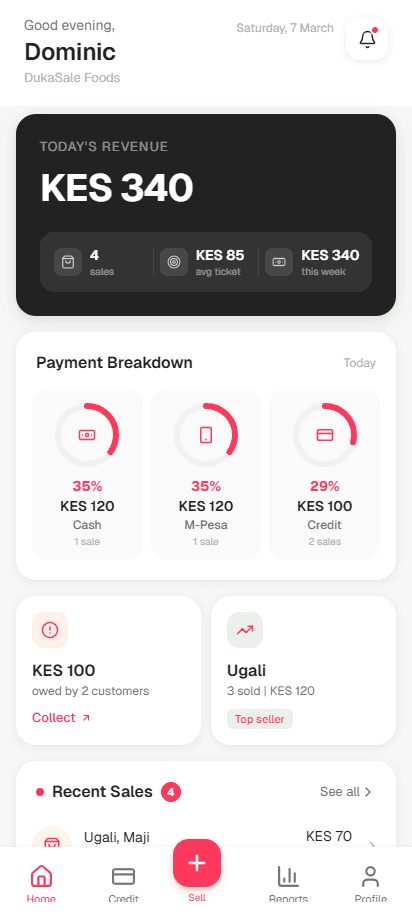
Today, a POS system can be an app on the smartphone you already own. It tracks sales, manages inventory, handles M-Pesa payments, monitors customer credit, and generates reports — all from your pocket.
5 Reasons Your Duka Needs a POS System
1. You Will Know Your Real Profit
The most dangerous phrase in small business is "I think I am making money." Without accurate records of every sale, every cost, and every expense, you are guessing. And guessing often feels more optimistic than reality.
A POS system records every transaction with the buying price and selling price. At the end of the day, week, or month, you see your actual profit — not an estimate. Many duka owners are shocked to discover that products they thought were profitable actually have thin margins when all costs are considered.
2. You Stop Losing Money to Errors and Theft
With manual records, mistakes happen. A sale is forgotten. Change is miscalculated. An employee gives a friend a discount without telling you. These small losses add up quickly.
A POS system creates an unbroken record of every transaction. If your staff handle sales, each person can have their own PIN, so you know who sold what and when. Discrepancies between sales records and cash in the till become obvious and traceable.
3. You Can Manage Stock Without Closing the Shop
Physical stock counts are necessary but disruptive. With a POS system tracking every sale, your stock levels update automatically. You can check stock levels from your phone, see which items are running low, and plan your reorders without counting a single shelf.
When you do physical counts (which you should still do periodically), you compare against the system numbers. Any difference flags potential issues — theft, damage, or recording errors — that you can investigate immediately.
4. Customer Credit (Deni) Stops Being a Headache
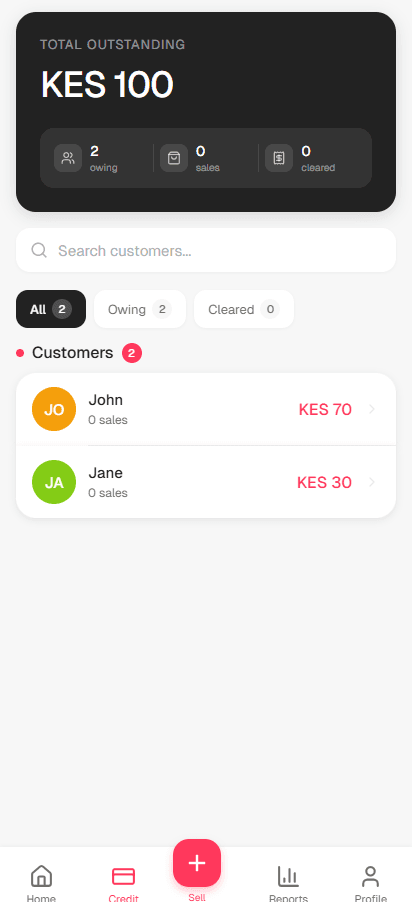
Every duka owner in Kenya deals with credit customers. A POS system tracks exactly who owes what, when they last paid, and their complete purchase history on credit. No more arguments about amounts. No more forgotten debts. No more torn notebook pages.
Some systems even let you see your total credit exposure at a glance, helping you decide when to tighten credit policies before your cash flow suffers.
5. M-Pesa Integration Saves Time
M-Pesa is everywhere in Kenya. A POS system that integrates with M-Pesa means you can record mobile payments alongside cash sales in one place. Some apps can even initiate STK push requests, sending a payment prompt directly to the customer's phone. No more manually checking M-Pesa messages to confirm payments.
But I Cannot Afford an Expensive System
This is the biggest misconception. In 2026, POS apps for small businesses in Kenya are either free or cost less than what you probably spend on airtime. Apps like DukaSale work on any Android phone, need no internet connection for daily operations, and cost nothing to download.
Compare that to the cost of:
- One stockout per week (lost sales of KES 500-1,000+)
- Unrecovered deni per month (KES 2,000-5,000+)
- Employee errors or theft per month (KES 1,000-3,000+)
- Mispricing or margin mistakes (KES 1,000-2,000+ per month)
The "free" notebook is actually costing you far more than a digital system ever would.
What to Look for in a POS App
Not all POS systems are created equal. For a Kenyan duka, look for these features:
- Offline capability — The app must work without internet. This is non-negotiable in Kenya.
- M-Pesa support — Integration with Kenya's dominant payment method.
- Deni tracking — Built-in credit management with customer profiles.
- Simple interface — If it takes more than a day to learn, it is too complicated.
- Reports — Daily, weekly, and monthly sales and profit summaries.
- Multi-staff support — PIN-based access so employees can use it without full access to your data.
- No monthly fees — Free or very low cost, because your margins are already tight.
Getting Started is Easier Than You Think
Switching from paper to digital does not have to happen overnight. Start by entering your most popular products (your top 20 items probably account for 80% of sales). Use the app alongside your notebook for a week. Once you see the difference in accuracy and convenience, you will not want to go back.
The Bottom Line
A POS system is not a luxury for big supermarkets anymore. It is a basic tool that every Kenyan retailer — from a roadside kiosk to a neighborhood duka — can and should use. The technology is free, it runs on your phone, and it pays for itself by preventing the losses you did not even know you were having.
Ready to try DukaSale?
Free POS app for Kenyan dukas. Track sales, inventory, M-Pesa payments, and customer credit — all offline.
Download Free