How to Use Sales Reports to Grow Your Small Business in Kenya
Learn how to read and act on sales reports to make smarter business decisions. Practical tips for Kenyan duka owners on using data to increase revenue and cut costs.
Your Sales Data is a Goldmine
Every sale you make tells a story. When you sold it, what the customer bought, how they paid, and how much profit you earned — these are not just numbers. They are insights waiting to guide your next business decision.
Most duka owners in Kenya know roughly how their business is doing. "This month was good." "Last week was slow." But rough knowledge is not enough to grow. Growth comes from specific insights: which products drive your profit, which days are busiest, which payment methods your customers prefer, and where you are quietly losing money.
Key Reports Every Duka Owner Should Read
Daily Sales Summary
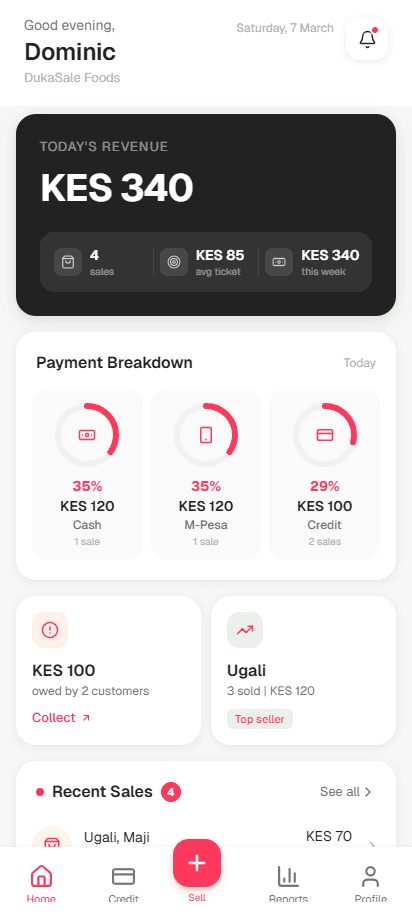
This is your most basic report — total sales for the day, broken down by payment method (cash, M-Pesa, credit). Check this every evening before closing. It takes 30 seconds and gives you an instant health check on your business.
What to look for:
- Is today's total above or below your daily average?
- What percentage was cash vs M-Pesa vs credit?
- If credit is creeping up, you may need to tighten your deni policy.
Product Performance Report
This shows which products sell the most (by quantity and by revenue) and which generate the most profit. These are often different lists — a product that sells 100 units at thin margins might generate less profit than one that sells 20 units at high margins.
Action steps:
- Never run out of your top 10 sellers. These items bring customers to your shop.
- Review bottom performers monthly. Products that barely sell are tying up capital. Consider dropping them or reducing your order quantity.
- Compare margin percentages. If a product has a 5% margin, even high sales volume does not help much. Prioritize stocking items with healthy margins (20%+).
Weekly and Monthly Trends
Looking at sales over weeks and months reveals patterns you cannot see day by day:
- Which days of the week are busiest? Staff and stock accordingly.
- Is there a monthly cycle? Many dukas see spikes around payday (end of month) and dips mid-month. Plan your stock purchases to match.
- Seasonal patterns? December holidays, school term starts, rainy season — each affects what customers buy and how much they spend.
Credit (Deni) Report
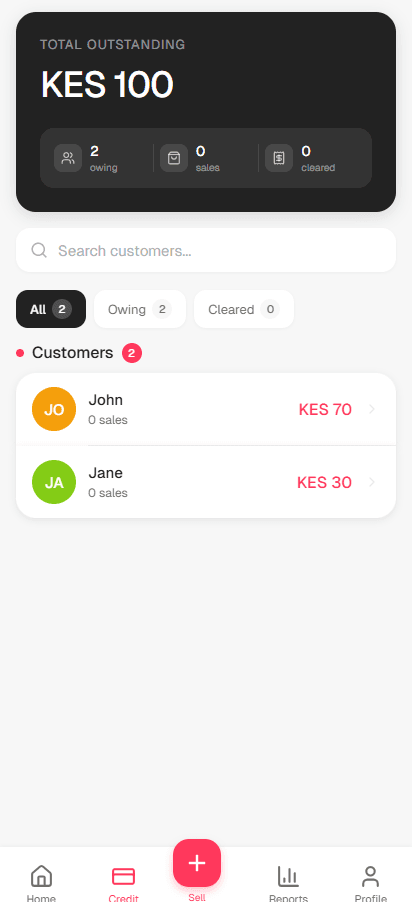
Track your total outstanding credit, who owes the most, and how old the debts are. Debts older than 30 days are increasingly unlikely to be paid. This report should drive your collection efforts and credit policy decisions.
Expense Report
Revenue is only half the picture. Track your business expenses — rent, electricity, transport, supplies, staff wages — to understand your true profit. Many businesses with strong sales are barely profitable because expenses are not controlled.
Turning Data into Action
Reports are useless if you do not act on them. Here is a framework for making data-driven decisions:
The Weekly Review (15 minutes)
Every Sunday evening or Monday morning, review the past week:
- Total sales vs your target — are you on track?
- Top selling products — do you have enough stock for next week?
- Credit balance — has it grown or shrunk?
- Any products that ran out of stock — and did you lose sales because of it?
The Monthly Deep Dive (30 minutes)
At the end of each month:
- Compare this month to last month and to the same month last year (if you have that data).
- Calculate your actual profit after all expenses.
- Identify your top 5 and bottom 5 products by profit contribution.
- Review your credit situation — total deni, aging, and collection rate.
- Set a sales target for next month based on the trends you see.
Common Mistakes When Using Reports
- Only looking at revenue — Revenue means nothing without knowing your costs. A product with KES 100,000 in sales and KES 95,000 in costs is not as good as one with KES 30,000 in sales and KES 15,000 in costs.
- Ignoring small leaks — A few hundred shillings lost to shrinkage, mispricing, or unrecorded transactions adds up to thousands over a month.
- Not comparing periods — One day's or one week's data is noise. Compare over time to see real trends.
- Analysis paralysis — You do not need to understand every number. Focus on the five or six metrics that matter most: total sales, profit margin, top products, stock levels, credit balance, and expenses.
How a POS System Makes Reporting Effortless
With a paper system, generating reports means hours of adding up columns and doing calculations. With a POS app, reports are generated automatically from your sales data. You just open the reports section and the numbers are there — daily, weekly, monthly, by product, by payment method.
Apps like DukaSale generate these reports from every transaction you record. No spreadsheets needed. No accounting knowledge required. Just clear, visual summaries of how your business is performing.
Setting Goals Using Your Data
Once you have a few weeks of data, set specific, measurable goals:
- "Increase daily sales from KES 8,000 to KES 10,000 by stocking more of my top 5 sellers."
- "Reduce deni from KES 25,000 to KES 15,000 by enforcing credit limits."
- "Improve profit margin from 18% to 22% by negotiating better prices with suppliers for my top 10 products."
Specific goals based on specific data lead to specific actions. This is how small businesses grow — not through guesswork, but through informed decisions.
The Bottom Line
You do not need an MBA to use sales data effectively. You need consistency — recording every transaction, checking your reports regularly, and acting on what the numbers tell you. Start with your daily sales summary and product performance. Build from there. The data will show you exactly where your opportunities and problems are. All you have to do is look.
Ready to try DukaSale?
Free POS app for Kenyan dukas. Track sales, inventory, M-Pesa payments, and customer credit — all offline.
Download Free